
Luxury Scented Candle Set
Three winter scents — pine, vanilla & cinnamon. The gift that never misses.
Twenty-five doors, one for every day from December 1 to Christmas morning — each hiding a small festive moment: an activity, a treat, or a tiny tradition.
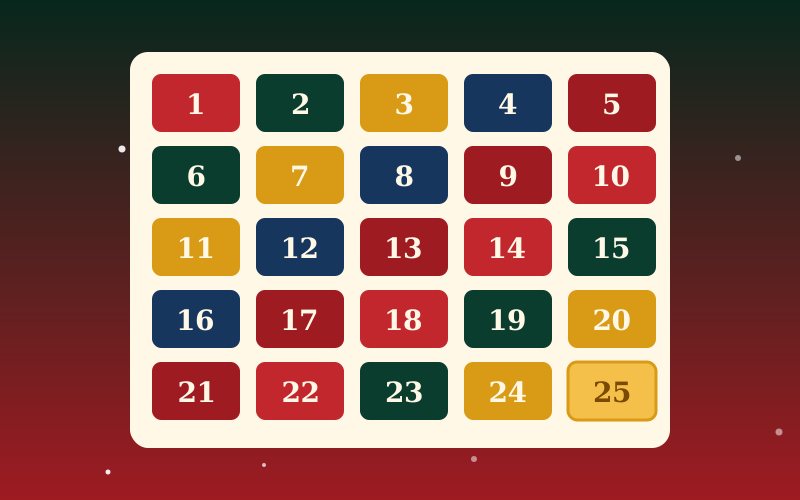
Advent begins December 1 — door 1 unlocks in 29 days in your timezone. One door unlocks per day through December.
Advent is the season of preparation and anticipation before Christmas, running through December. The Advent calendar turns it into a daily ritual — one door a day, building the excitement in small, happy steps instead of one overwhelming week.
Behind these doors you will find the rhythm of a good December: a hot-chocolate night, a movie, a baking day, a kind deed, a card to send. Families often open the day's door at breakfast — by Christmas morning, the month has become a string of memories, not a blur.
The 25 surprises in this calendar are arranged as a December story, not a random pile. The first week is about starting: write the wishlist, hang the lights, send the first card. The middle doors turn to making and giving — baking, wrapping, donating a toy, building the gingerbread house. The final week slows down on purpose: read a story, set the table, take the photo by the tree, and finish with an early night before the big day. Door 24 points at Santa; door 25 is simply the day itself. If your family uses the calendar as a morning ritual, that arc gives December a shape children can feel.
Strictly, the season of Advent begins on the fourth Sunday before Christmas — in 2026, that is November 29 — while Advent calendars almost always start on December 1 and run for exactly 25 doors. Both facts live happily on this page: the countdown treats December 1 as opening day, because that is when the first door opens in most homes. Doors before "their day" are the calendar's one great temptation; this digital version lets you peek in demo mode, which families have used, entirely predictably, to negotiate.
Advent calendars secretly teach the skill December most requires: pacing. One door a day is the anti-binge — joy in daily instalments, anticipation stretched instead of spent. Families can borrow the structure for everything else: one festive film per Friday instead of a marathon, one baking project per weekend, presents opened in rounds rather than a single avalanche. Children who learn to love the wait are not being denied anything; they are being given the month's best gift early, which is more December. If your household's calendar runs out of doors before excitement does, that is what the rest of this site is for — the countdown for the number, the tracker for the story, and door 25 for the day itself, arriving right on schedule.
Somewhere around age thirteen, the chocolate calendar is declared childish — and secretly missed for years. The grown-up versions fix this by changing the cargo, not the ritual: 25 tiny notes (a compliment, a memory, a plan for the new year), 25 miniature treats with standards (good chocolate, specialty tea, a different hot sauce for the brave), or 25 micro-experiences — a walk after dark to see the lights, one song sung properly, one page of a story read aloud. Build it with envelopes on a string, swap with a partner or a sibling so the contents stay surprising, and defend the one-door rule with your life. Advent works on adults exactly as it works on children, because anticipation was never really about the chocolate.
Every family meets it: December 26, an empty calendar, and a small person asking for door 26. Prepare the traditional answers now. The calendar "rests until next December", the doors "refill while everyone is asleep next November", and — the masterstroke — one unofficial door exists: a final treat hidden for the day after, labelled Boxing Day, which turns the ending into a ceremony instead of a cliff edge. Rituals end best the way stories do, with a small, satisfying final page.
One door per day, in order, for the full effect.
Each door suggests a small festive moment.
Door 25 opens on the big day itself.