
Luxury Scented Candle Set
Three winter scents — pine, vanilla & cinnamon. The gift that never misses.
Three questions stand between anyone and Santa's verdict. Slide honestly — Santa already knows, this is just the paperwork.
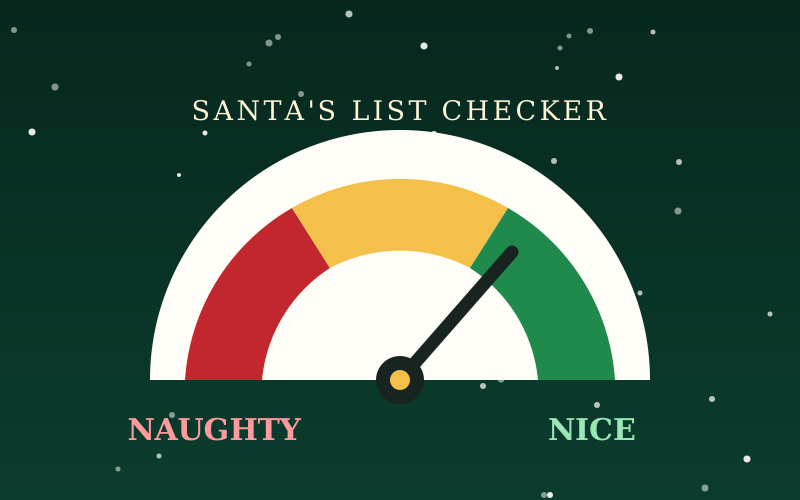
Kindness counts double in spirit: sharing and helping push the needle toward Nice, while present-peeking pulls it back. The final score is out of 100 — 75+ is Nice List confirmed, 45–74 is mostly nice, and below that lands on Santa's watch list, where a few kind deeds before December 24 can still save the day.
It is a game, of course — but it has started more honest family conversations at the Christmas table than any lecture ever has.

The three sliders are weighted the way Santa's list has always worked in the stories. Everyday kindness — sharing, helping, including others — counts most, because it happens when nobody important is watching. Helpfulness without being asked counts next: it is the difference between being good and being good on purpose. And present-peeking is the playful deduction, the one naughty-list behaviour every child recognises and most adults quietly confess to. Combine them and the pin lands where the year deserves — almost everyone ends up somewhere interesting in the middle, which is exactly where the fun is.
The meter is a toy, and its verdicts are entertainment — no child's Christmas has ever actually depended on a slider. Used well, it starts the best December conversation there is: what does being "nice" actually mean in this family? Sharing when it costs something, helping before being asked, and telling the truth about the peeked present are a pretty good working definition at any age. If the pin lands left of where someone hoped, the official remedy is also traditional: there is still time before Christmas Eve, and hot chocolate improves almost every score.
The idea that Santa keeps a written list — and checks it twice — comes straight from the 1934 song "Santa Claus Is Comin' to Town", which turned older folklore about Saint Nicholas knowing children's behaviour into a piece of admin every child can picture: a list, a pencil, a second check for fairness. Our meter is that song turned into an instrument. The "twice" matters more than people think: it means the first impression is not the verdict, the year is reviewed properly, and a bad Tuesday in March can be outweighed by a kind November. That is, when you think about it, a rather hopeful piece of mythology to hand a child — your whole year counts, not your worst day — and it is why the meter always leaves room for a late climb toward Nice.
Santa's list, in the stories, rewards the whole year — so here is what a quietly "nice" year actually looks like, for anyone planning a late comeback. Spring: sharing without being asked and helping one person move something heavy. Summer: including the new kid, the new neighbour, the quiet cousin. Autumn: telling the truth when a small lie would have been easier. December: the home straight — chores done before being asked, presents peeked at zero times (officially), and a card written to somebody who will not expect one. None of it is heroic; all of it counts, twice-checked. The meter's sliders are a toy version of that list, which is why moving them together, honestly, tends to end with a family agreeing on a score that feels fair — and fairness, at Christmas, is the whole game.
House rules from years of meter sessions: grandparents are checked with the sliders pre-set to generous, because they have had decades to accumulate evidence and most of it is lovely. Pets are judged on a separate, secret scale where the cat starts at Naughty and the dog starts at Nice, and both consider this fair. New babies receive an automatic Nice verdict and a printed certificate is traditional. The meter accommodates all of this with a straight face — it understands that the list, like Christmas itself, runs on love first and evidence second.
Kids, partners and grandparents all qualify.
Sharing, helping, and the present-peeking question.
Share the screenshot — verdicts are binding until Dec 24.